
People I Have Known
Amparo: Inspiration, Role Model, Friend

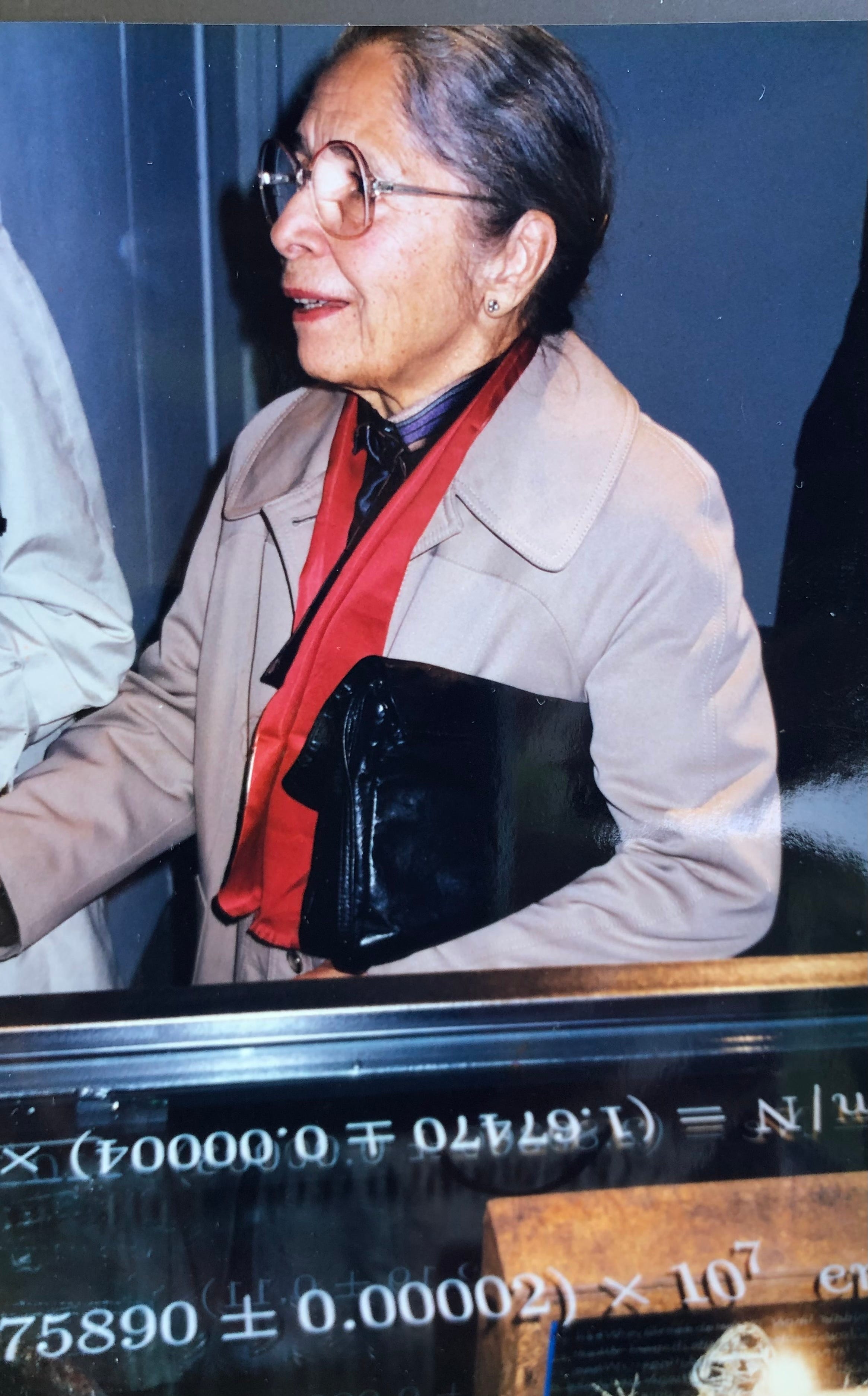
“Her conversation is delightful; it is so entertaining, so gay, so enlivening when she is in spirits, and so intelligent and instructive…”
In 1980, when I was voraciously reading just about anything I could lay my hands on, I copied the above quote by the 18th century English novelist Fanny Burney into my journal. Apparently she had said this of a Mrs. Thrale. I didn’t know who Mrs. Thrale was, but I loved the quote, so I wrote it down, and added “the same is true of Amparo.”
Amparo was the mother of my first serious boyfriend. She was also one of my most important and most inspiring role models, especially as a model of how to grow old gracefully, with unflagging energy and enthusiasm for life, and especially for learning. She once told me about how she had been stuck at Penn Station for 2 1/2 hours waiting for a friend of hers (“the widow”) to arrive from Buffalo. She said she welcomed times like that “because then I can just sit and read.” She was so absorbed in studying German grammar that when the train arrived she didn’t even notice the change on the arrivals board. Suddenly her friend was standing over her and smiling. “Oh,” she said to me in recounting this little episode, “I was so mad! Because I was just in the middle of an exercise. I felt like saying ‘Go back to the train, I’ll be done in a minute.’”
She had a sense of humor that revealed itself in often rather subtle, sophisticated ways. On her bookshelf, placed adjacent to each other, were three books that suggested not only her passion for classical music, but also the breadth of her curiosity, and her sense of humor—The Great Singers; The Great Pianists; The Great Dirigibles were always there, lined up in just that order, sandwiched between a wide variety of other books on various and sundry—often quite esoteric, always intriguing—topics.
When I first knew her, she was in her late 60s; and she loved to joke about her age. She often referred to herself as “old and decrepit” and would add proudly that for that reason she got discounts at movies, on buses, etc. When she saw some old, bent figure shuffling down a sidewalk she would whisper, “Look, see? He’s in my age-group,” and smile behind her cupped hand, impishly.
When I broke up with her son it was in some ways even harder for me to let go of my relationship with her than my relationship with him. He was an important intellectual mentor for me, and a dear friend; she was also an important intellectual mentor, but more importantly she was a role model for how to not only survive the inevitable vicissitudes of life with grace and resilience, but how to come out better for them in the end.
Fortunately I didn’t have to break up with either of them forever; after a few months of bitter separation, both of them forgave me for leaving him, and allowed our friendships to flourish. She continued to be a good friend to me, and became an even better one in the years that followed.
Amparo was a survivor: she had been orphaned at an early age and raised primarily in a Catholic orphanage in Puerto Rico, which left her with a lifelong contempt for Catholicism. She told me once that she had decided to have her son get his religious education from the Quakers because of the antisemitic notions Christian Sunday Schools sometimes encourage, whether purposely or not. She said the Quakers were much more tolerant and “Also, they don’t believe in hell.”
When years later she learned that I was going to baptize my sons she didn’t hesitate to express her disapproval of infant baptism. “Foisting such a thing upon innocent babies when they can’t object,” she said, shaking her head and adding an exaggerated scowl. (She had a wonderfully expressive scowl, which she often assumed for dramatic effect.)
As a young woman Amparo had come to New York, where she met the son of a prosperous WASP family from Michigan who married her, impregnated her, and shortly after abandoned her. The child of that union was my boyfriend, who was named after his father, with a “III” affixed to his name, as if Amparo intended to insist upon proudly proclaiming the family connection that the baby’s paternal relations did not wish to recognize.
In writing this piece I was surprised to discover a 1935 New York Times article that reported that Amparo, along with a few other left-wing members of the New York Socialist party had been expelled from the party “on the ground that they had advocated armed insurrection to promote socialism.” I had never heard anything about this from either her or her son. I would love to know what she would have had to say about it. While advocating armed insurrection does not sound at all like the woman I knew, her socialist sympathies were strong and clear. She often referred, with disgust, to the US-backed ouster of Mohammed Mossadegh in Iran, and the way the US government had rejected Castro’s attempts to reach out to the US in the wake of the Cuban revolution. (“He came to Washington with his hat in his hand, and they turned him away,” she said frequently, frowning and shaking her head.)
She raised her son alone, with (I believe) very little if any financial support from his father, and no emotional or any other kind of support at all from him. She became a nurse, and for many years she worked with Dr. Nathan S. Kline, known for his pioneering work with psychopharmacological drugs at a research unit he created at the Rockland State Hospital in Orangeburg, New York.
It was thanks to Amparo that I developed an appreciation for opera, after being treated to quite a few performances at the Metropolitan Opera with her. It took a while for me to develop a taste for it. I went to the performances more because I knew she wanted me to come, and I enjoyed spending time with her, than for the music. But finally, at one performance I was brought to a sudden, breathtaking understanding of what opera really is, what it can do, during the sextet in the finale to Act II of Donizetti’s Lucia di Lammermoor. Suddenly I felt, in a rush of emotion, the overwhelming power of the intricate and masterful blending of story and song; and with the perfect harmonizing of those incandescently beautiful voices, I understood. I understood why opera is such a beloved art form, and why it moves people to tears. In the years since I have developed other favorite moments in various operas, but that first time was really special, a moment I won’t ever forget.
She also often invited me to go with her to plays at the Roundabout Theater, where she had a subscription for many years. “What’s the play?” I would ask when she invited me to go to the next one with her. “Play Number One,” or “Play Number Three” would be the answer—which play it was didn’t matter all that much to her, it was going to the theater that was important. It was for me as well, and I saw a good many wonderful plays with her that way, along with some that were less impressive. Always a good part of the enjoyment of the evening was just being with Amparo.
She was a gifted storyteller with always some little story to tell; I captured a few of them in my journals.
March 25, 1980 She has a charming, somewhat old-fashioned, foreign & very imaginative way of speaking English; she gestures & uses her hands and her head & her eyebrows all to good comic effect that I can’t describe because I am not a very good writer. She is as disgusted by roaches as I am, yet was horrified to find out exactly how the “Roach Motels” she bought work. (The roaches are enticed inside of a box by a scent that draws them to the box—some sticky substances coat the inside—and because they can’t escape, they starve to death slowly.) She peeked inside one one day and saw the insects’ antennae waving and she said “Oh my God, now it’s such a moral dilemma. I looked in there & I saw!…” (She grimaces and moves her index fingers back and forth, like windshield wipers at the top of her forehead). “I can’t stand the thought of any fellow creature dying that way. I thought they died straightaway,” she says, frowning and shaking her head.
She would also often come out with thoughtful, philosophical remarks seemingly out of the blue, but they weren’t out of the blue at all—her mind was always at work.
May 28, 1990 I called Amparo this morning. How will I ever capture her priceless dialogue when she is gone? Today she said “Oh my, yes. I think I am really going to have a heart-to-heart talk with God when I get to heaven. It seems to me we need two lives—one for being an animal, you know, and one for using our minds, which are so wonderful. One wastes so much time from about 16-28 just with gonads & hormones. And so many people ruin their lives in that period.” She is such a bundle of vitality…a bundle of energy & life.
She was also my soulmate in the art of losing things. Once when I was in the midst of throwing a fit, looking for something I had lost—in this case I think it was a letter—I was storming about her son’s apartment, railing about how could something disappear, just disappear, like that, I had had it in my hands, and now it was nowhere to be found, how can this even be?!… My boyfriend, who was used to these fits, waited quietly for the letter to be found and the storm to pass. But Amparo quietly expressed sympathy, and understanding of the situation. “I’ve been losing things all my life, it drives me crazy!” I said. “Me too,” she said, quietly, calmly. “Really?! You’ve been losing things all your life too?” I asked. “All my life,” she said, quietly, gravely, nodding her head and looking very serious. “Well,” I said, “Now I feel better. I mean if you have been losing things all your life and you’ve managed to get to this age without it unhinging you, I guess I can learn to do that too.” And she laughed. We both laughed.
She didn’t entertain often in her small Chelsea apartment, but when she did it was always lively. One night she somehow made room for 18 guests—it was an eclectic mix of her friends, her son’s friends, and children of some of her friends. This particular group included a professional organist, a software engineer, Amparo’s childhood friends from Puerto Rico (Lola, Ana Luisa, and Tula, who she always called “las niñas”), a Westbeth collage artist and her gay Brazilian boyfriend, a Howard University professor of political philosophy from somewhere in the Caribbean, and a Newsday business reporter. “Everyone loved Amparo’s ‘age-group’ friends,” I noted in my journal, and I do remember that the elders that night were all full of a zest for life, and that they told lively stories from “back in the day” that had us all laughing.
At Christmastime Amparo would go about making cookies to give as gifts. She made a call for cookie tins, and then set up a cookie-making operation in her kitchen. “My mother has made more cookies than anyone has ever made in the history of the world,” her son announced to me one night in early December when I stopped there to deliver some empty tins. She also invited us over every year sometime during the holidays, for her Brandy Alexanders. Occasionally when I was in town for some evening event, in the days before we had a car and Steve could pick me up at the subway, I would stay overnight in her apartment. She would make me hot chocolate and we would “chat.” So she was, in addition to being an intellectual mentor and a soulmate in the art of losing things, a 70-something “girlfriend” to me.
She had friends everywhere and was very generous about sharing them. On my first trip to Europe she sent me with a letter of introduction to one friend in Amsterdam, and another to a family in Madrid who treated me very well indeed. Later she enjoyed bringing her European visitors—especially young visitors, often children of her friends—to visit my husband’s sculpture studio in the Brooklyn Navy Yard.
June 15, 1991 Last night we had a barbecue at the studio. It was a lovely early-summer night with a beautiful (gently apricot, pink & blue) sunset… After dinner we took a stroll along the (only) pier open to us anymore. The Circle Line has taken over “our” pier and the night watchman won’t allow us to walk down there without permission from the owners of the Circle Line. So it’s off-limits for now. Miss Liberty and Miss Freedom sit bobbing in the slip and occasionally the night watchman appears from her perch on high to make sure we’re not trespassing. So we take our walks on the pier just to the north, next to the abandoned, vandalized ghost-ship, a ferry with burnt-out interior & broken windows which sank the other night in a big thunderstorm. There is an old gangplank on the pier that everyone traipsed across—I was following behind them with Amparo—we were discussing the Persian Gulf War and the ridiculous “Operation Welcome Home” celebrations earlier this week…Suddenly she looked at me, gesturing toward the skyline, the boats, the scene as a whole, and she said “This is your life, you know! Don’t forget it…I was always thinking about the future—but this is it, remember it!” And I said yeah, I had just been thinking about that.
She died, quite suddenly and unexpectedly, shortly after our younger son’s christening, at the age of 89. At his christening party, she had presented me with a gift she had made for him—a needlepoint sampler featuring the Islamic crescent; the Star of David; a lotus blossom; and a cross. “At least he can have some variety to consider,” she said as she presented it to me, rolling her eyes and then casting them upward. As things turned out, he majored in religious studies in college; and he still has the sampler.
I’m grateful to have had Amparo in my life. I often think of her; and—not always, but sometimes—it is when I have (once again) temporarily lost my keys. Or my glasses. Or an important piece of paper.
Then I stop fretting, I remember her—and I smile.
Janet Hulstrand is an American writer, editor, writing coach, and teacher of writing and of literature who lives in France. She is the author of Demystifying the French: How to Love Them, and Make Them Love You, and A Long Way from Iowa: From the Heartland to the Heart of France, a memoir. She is slowly and steadily working on her next memoir, A Cheap Loft in the West Village (and Other Dreams).
YES! You have done it again, captured a person who we all would have liked to know, and now we do. Thank you.
Great quote, Janet, and very lovely piece.
Who was Mrs Thrale, anyway?